OUR SCIENCE – Keeping Mitochondria Healthy is the Key
Healthy mitochondria are essential for neurons to function and survive. Neurons depend on mitochondria for far more than energy: they regulate calcium and other ions critical to neuron signaling; supply the building blocks for proteins, cell membranes, and genetic material; and sense cellular damage — triggering cell death when a neuron can no longer be saved.
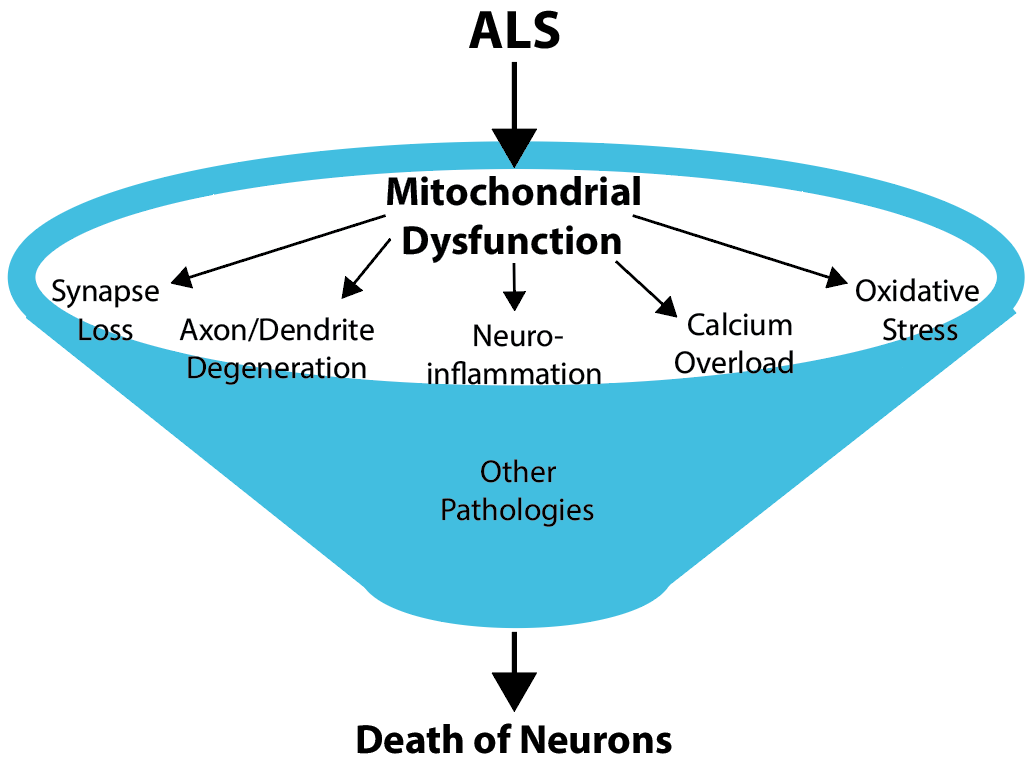
Mitochondria become dysfunctional early in ALS and other neurodegenerative diseases before other symptoms appear. Because they play so many roles in keeping cells healthy, their failure sets off a cascade of downstream damage: synapses are lost, axons and dendrites degenerate, neuroinflammation spreads, neurons accumulate too much calcium, and oxidative stress accumulates. Left unchecked, this cascade ultimately kills the neurons of the spinal cord and brain.
Each human neuron in the spinal cord and brain contain thousands of mitochondria that are distributed between the center of the neuron (the cell body) and the processes that connect neurons together – the axons and dendrites.
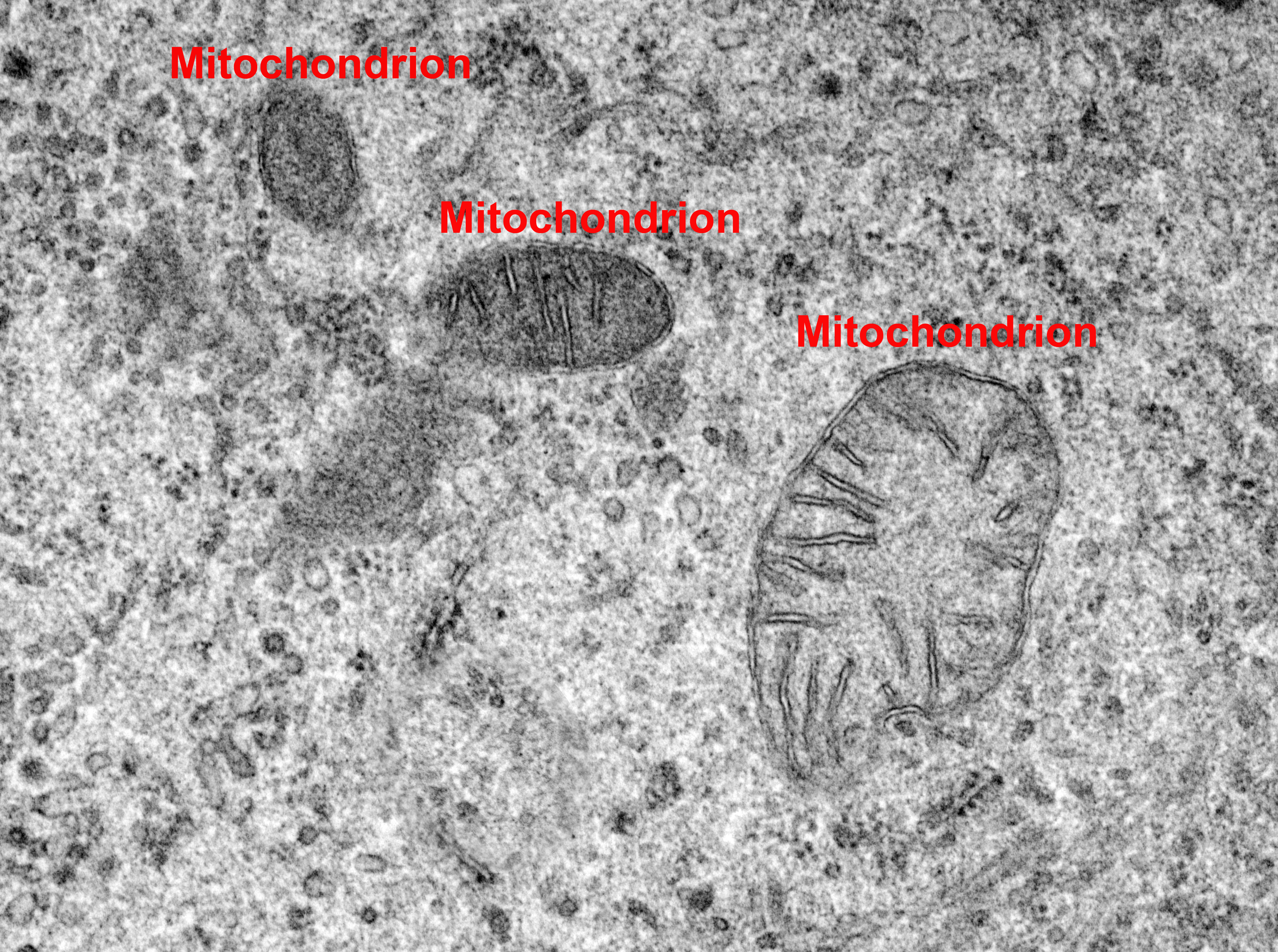
Electron micrograph of mitochondria
The novel compounds we are developing as future drugs protect mitochondria in ALS-diseased motor neurons — the very neurons that die in ALS — before they become defective. Protecting mitochondria also protects against related pathology, including axon and dendrite degeneration and early cell death. Our lead compounds have met two of the important milestones in the path to clinical development:
Proven to protect human, ALS-diseased motor neurons
Using motor neurons grown from ALS patient stem cells, our compounds preserve normal mitochondrial structure and function — and, most importantly, keep the motor neurons alive.
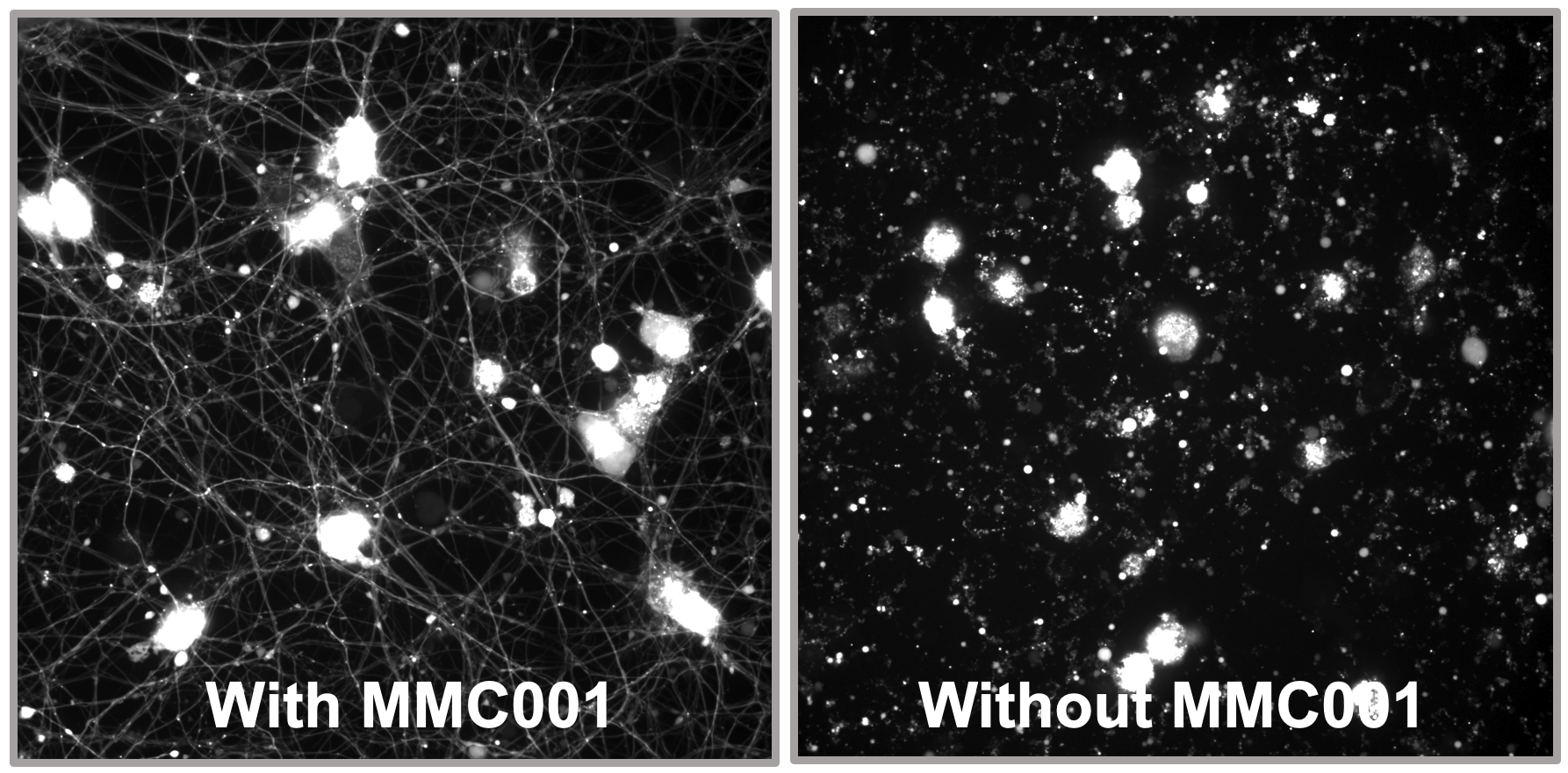
Motor neurons representing an ALS patient cultured for 30 days. The left image shows neurons treated with MMC001. The large white objects are the cell bodies. The thin white lines are the axons and dendrites that extend from the cell bodies to other neurons. The neurons are healthy and alive. The right image are neurons left untreated with MMC001. The neurons are dead, axons and dendrites degenerated. All that remains is a cellular debris field.
MMC001 extends motor neuron survival beyond day 160 — compared to just 18 days without treatment. This level of neuroprotection is unprecedented.
2. Proven to protect against ALS pathology in mice
Using a mouse model for sporadic ALS, we have found that our compounds offset several of the ALS-related pathologies that occur in the model.
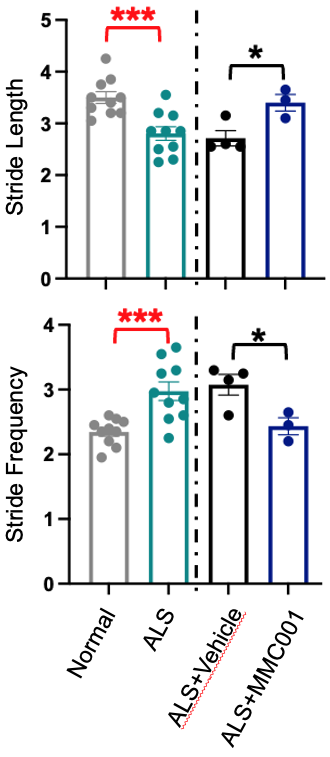
ALS model mice show gait abnormalities like in human ALS patients, as the motor neurons controlling walking become dysfunctional and die. Compared to normal mice, ALS mice take shorter, more frequent strides. Mice treated with MMC001 show a markedly different result: their stride length and frequency return to normal levels, while untreated (vehicle-only) ALS mice remain impaired.
MMC001-treated mice regain normal gait (as one example), with stride length and frequency statistically indistinguishable from healthy mice — while untreated ALS mice remain impaired. This functional recovery mirrors the neuroprotection we see using ALS-diseased cultured motor neurons.